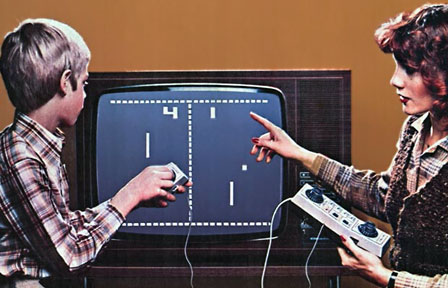
Today’s striking detail, realistic looking characters and fantastic game play immerse us in the game, but this was not always the case. In the industry’s early days gamers had to use their imaginations to completely integrate themselves within a game. Often, a couple of different colour rectangles were the only detail afforded to an alien space craft.
We know that computer and software technology have brought about dramatic changes in the look and feel of games, but some people still attest to the extraordinary playability of the early games that shaped the industry.
A tale of two cities. The fact that video games have become a multi-billion dollar industry can be attributed to two very disparate characters. One was young, nerdy genius and Pong creator Bushnell. The other was Nintendo’s Yamauchi – an old venerable stick-in-the-mud who never indulged in the games his company produced.
Youthful exuberance. The gaming industry essentially began with an MIT graduate, Steve Russell, in 1962. His SpaceWar was a very simple game of firing ‘missiles’ at blocks (alien space craft) and was housed in one of MIT’s supercomputers. It was played by a few MIT mathematics and electronic students.
One of these students saw the potential of the game and went on to create a similar game, Computer Space, in 1971. Computer Space took on the form that all early arcade games followed. A chipboard outer, encasing electronic circuit boards and a television. What set Computer Space apart from the earlier SpaceWar, was the fact that the machine was built solely to play the game and did not require the power of a supercomputer to run it.
Bushnell’s dreams of seeing his creation sold to pool halls, bars and bowling alleys across the US were dashed however. He produced 1500 Computer Space consoles and sold none of them.
The reason it did not sell was because of the game’s complexity: it required the potential player to read a full page of instructions before playing. Bushnell went back to the drawing board and the following year came out with the extremely simple Pong, made by his newly founded company Atari. Pong required far simpler instructions: “Insert coin. Avoid Missing Ball for High Score.”
He placed Pong in a tavern in the district which is now famously known as Silicon Valley. According to folklore, the tavern owner rang Bushnell the day after it was installed demanding, in no uncertain terms, Bushnell come and take away the machine as people were complaining it no longer worked. The ‘problem’ turned out to be that the casserole dish that served as the coin box within the machine was full to the brim with coins, such was the popularity of the game – a problem Bushnell was delighted to have to face. Pong went on to make a fortune for Atari, whose home console became one of the most popular Christmas gifts in 1975.
Atari lost their stranglehold on the industry after turning down the opportunity to own the American rights to Pac-Man, claiming the game was far too easy to play to be widely popular. Pac-Man went on to become one of the most popular games of all time.
The little chomper. Pac-Man was created from somewhat strange beginnings. Tori Iwatani of Namco was struggling to come up with a suitable character for his game. The story goes that Iwatani was eating a pizza when it hit him. He envisaged a pizza with a slice missing for a mouth. And so the most widely sold character was born. The game was originally called Puck Man. The American importers knew their market well enough to recognise the ease with which the name could be altered into an offensive word: regrettably we will never know how many more consoles would have sold under this guise. In 1982, Pac-Man was rated Time magazine’s ‘Man of the Year’.
From these innocent beginnings sprang the domination of the market by Japanese manufacturers.
The second phase. Anyone who believes video games are kids’ stuff is very much mistaken. Sure, when the industry was in its infancy in the early 1970s, it was limited to a couple of arcade games in pool halls, bowling alleys and milk bars. Because the graphics were basic, the games were more attuned to younger generations and demanded an enormous level of imagination to believe that a little blue square was actually a powerful, intimidating alien spaceship.
Since then, the graphics have improved dramatically, eliminating the need for such tireless imaginative powers, but also allowing game play to become more intuitive, and thus bringing older (less imaginative?) generations into its market.
Thanks to innovative Japanese games manufacturers, the gaming industry became a powerful institution in the late 1980s and early 1990s. The US was alarmed by the rapid rise of Nintendo gaming systems throughout its homes, and expressed concerns about the possible effects on the youth of America. Intending to pour scorn on the US reaction, a Nintendo representative issued a statement in 1989 that has since become famous as a disturbingly accurate prediction of 1990s rave culture. He said: “If computer games had a bad effect on children, then by now we would have young adults running around darkened rooms, swallowing little yellow pills and listening to repetitive electronic music.”
Nintendo controls the market. The success of the largest Japanese game manufacturer, Nintendo, was phenomenal. In 1991, Nintendo’s earnings outstripped Sony’s earnings by US$400 million. In 1992, Nintendo earned as much as the American film studios combined, and made more profit than any of them. Super Mario Bros 3 made US$500 million in the US alone. To put it in an entertainment industry context, that was about the same as the gross earnings of ET.
The tyrant. Surprisingly, the success of Nintendo was due solely to the marketing genius of a Japanese businessman who had never played a video game in his life.
Yamauchi attributed the focus of game design to his video game ‘artists’ rather than technicians. Yamauchi stated that “an ordinary man cannot develop good games no matter how hard he tries. A handful of people in the world can develop games that everybody wants.” (Seff, D Game Over: Nintendo’s battle to dominate an industry, 1993, p.38).
Yamauchi was an audacious customer who went against many business models while creating his empire. Even though he had never played the games that made up his industry, he had a remarkable understanding of what would be universally playable. He alone held the responsibility of which games would continue in development and which games would be released.
Like many Japanese industry leaders of the 1990s, Yamauchi was a ruthless employer, manipulating and terrorising both his employees and the market. Many described him – based on a combination of awe and fear – as a genius with incredible intuitive ability.
He put all his faith in his research and development section. They were his stars and competed for his attention like gifted children under an overarching, domineering paternal figure (which may not have been too far from the truth).
He determined that no one was to influence his R&D team; his creative team were there to create, and outside influences could only hinder their creativity. While other companies assumed market research was of great importance to understanding the market, Nintendo was interested in moulding the market’s understandings by creating new and fresh games. They believed that creating games based on what was popular at the development stage had little to no chance of being revolutionary on the release of the game.
 Shane Stephens