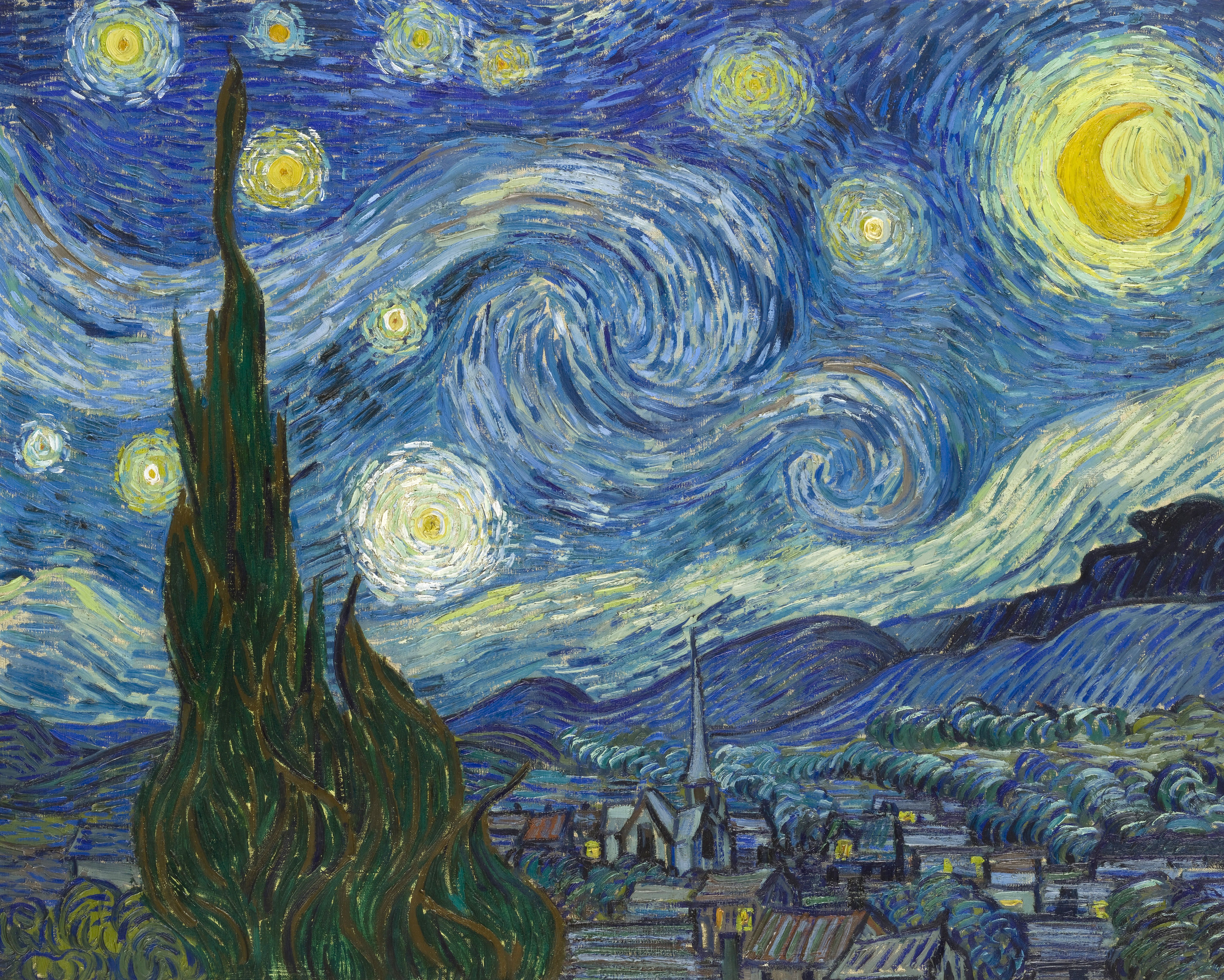
What is about great art and mental health? How is it that people considered ‘strange’ can move us so profoundly, can reach into our depths and strike a familiar chord? Perhaps it’s because we are not quite as ‘sane’ as we lead ourselves to believe. Let us take a walk through perception and the unconscious to see the true nature of art and consequently ourselves.
From the beginning, people have scrawled effigies on cave walls and worked rocks into approximations of figures to express themselves. Art, and the genius that occasionally arises within it, is more than merely approximation, it is expression – an exact replica of an object is not necessarily great art. Great art is expression of the highest order.
Part of the trick to creating works of genius is to immerse yourself in the work. In fact, it could be argued that talent is quite unnecessary (many artists considered quite brilliant don’t seem to have any ‘talent’ at all). No, the real trick is to allow your whole self to create the work: allowing your unconscious to contribute to the creation, that part of you that is inaccessible by the conscious mind that works on a parallel field.
Van Gogh and the whole ear thing. It is by no means accidental that some of Van Gogh’s greatest works were the sunflowers. And when we look at the passion and devotion behind the painting of those works we can see why they are considered so beautiful. The story goes that his much loved brother was coming to visit and Van Gogh wanted to decorate the room in which his brother was to stay – to brighten it up, as it were.
He dedicated himself religiously to this project, painting 14 works (although the amount is widely debated) in quick succession. Van Gogh was troubled throughout his life, wanting to be a preacher but being turned down by the clergy. He was a man who found it difficult to interact with people but loved them nonetheless, especially his family. As viewers we can see this love expressed in these paintings. They express exactly what he intended – happiness.
His ‘boots’ painting expresses the fondness and familiarity of an old pair of boots that had walked many paths with him, exactly the emotion that a familiar pair of boots inspires. And how did he capture this? He would buy a pair of boots and literally walk for weeks around the streets of Paris until they were worn out. Immersing himself not only in the actual painting of the object but in creating a strong bond with the object itself.
This is where great art separates itself from the mundane. The great artists have the ability to recognise the innateness of the object. The ability to stir the viewer’s own unconscious, something that is universal in all of us. And this is why the discussion of genius within art becomes so subjective. To use rational argument, the conscious mind, to describe something that occurs deep within the unconscious, is nigh on impossible.
This stirring of the unconscious does not merely limit itself to works that feature recognisable objects or places but also works that deal in non-figurative art. As Carl Jung wrote: “Fascination arises when the unconscious has been moved. The effect produced by works of modern art cannot be explained entirely by their visible form. To the eye trained in ‘classic’ or ‘sensory’ art, they are new and alien. Nothing in works of non-figurative art remind the spectator of his own world, no objects in their own everyday surroundings, no human being or animal that speaks a familiar language. There is no welcome, no visible accord in the cosmos created by the artist. And yet, without any question, there is a human bond. It may be even more intense than in works of sensory art, which make a direct appeal to feeling and empathy” (Man and his Symbols, p.287).
Modern art’s triumphs of expression. Duchamp and the Cubist movement made some huge inroads into the unconscious and its importance to creativity. It could be argued many artists before this had used their unconscious to develop their work – for instance, Beethoven was completely deaf when he wrote his final concerto, hearing the entire piece and its orchestration within his head. But artists such as Duchamp questioned the visual basis of painting and freed art of its dependence on the exterior world. “I wanted to get away from the physical aspect of painting,” Duchamp said in 1946, “I was interested in ideas – not merely visual products. I wanted to put painting at the service of the visual mind” (The World of Duchamp, p.8-9).
Similarly, Salvador Dali spent much time trying to express directly from the unconscious mind.
The Cubist painter Picasso discarded conventional beauty and the imitation of nature. He was obsessed with the inner reality and went to great lengths to transfigure form – as Picasso’s famous phrase stipulates: “Not what you see, but what you know is there.”
Many great artists within their chosen fields have claimed it is their deep association with their art that creates works of genius. Such association and meditation allow the unconscious to express itself. Tolstoy wrote that one mustn’t invent, one must let things happen. He believed Anna Karenina was more than just a literary character in a fictional novel. She was not merely his creation, but a person with autonomy. It appears that his unconscious was developing the story in cohesion with his conscious mind, making it seem to Tolstoy that the character had freedom beyond his control.
It is not surprising then that we find the diligent artists behind works of genius a little ‘strange’. Considering that they toil heavily within the dark realms of the unconscious it makes sense that the rest of us find their behaviour at times a little odd. Regardless of this apparent disassociation, we remain interconnected with their work, which would seem to highlight the facultative nature of our own unconscious.
 Shane Stephens